As I entered China, even the officials seemed surprised. “Chongqing?” they asked repeatedly, as if my destination must be a mistake. In fact, this choice is somewhat unusual for a first visit to China. Chongqing is a metropolis in the province of the same name and has gained a certain degree of fame for its urban architecture. Videos of the three-dimensional labyrinth city are circulating all over the internet. Chongqing is built along a hill and therefore stretches across multiple levels, which is why it’s easy to lose track of which floor you’re actually on. The most famous spot for this is Kuixinglou Square, which you enter from the street. You seem to be standing in a normal, ground-level square, surrounded by tall buildings, until you reach a railing at the end of the square. At this point, the square ends in a steep drop of 22 stories to the next street.
On the taxi ride from the airport to downtown, I can hardly stop marveling. All the buildings are brightly lit, and the massive skyscrapers that make up the entire city center leave an incredible impression. We drive across one of the large bridges over the Yangtze River into the Yuzhong Peninsula district, and as I press my face against the taxi window, I realize I still have it: my childlike curiosity.
I check into my cozy little hostel, where I’m paying just over eight euros a night. It’s located right on Mountain City Alley, making it a great base for exploring. The bunks beds have their own curtains and each person gets their own locker; the bathrooms are clean, and there’s a large common room outside the dorms. This checks all the boxes for what I expect from a good hostel. In the evening, I grab a bowl of noodle soup from one of the many food stalls around the corner before falling into a long, deep sleep.
My next breakfast will be baozi—steamed buns filled with meat. By now, I’ve reached a point where I plan my day from meal to meal and am simply sad that I have to be full in between and can’t try even more. I pay six yuan for the baozi. As I pay, the seller —an elderly, petite woman—gestures with her hand. She extends her thumb and pinky from an otherwise clenched fist, making the sign I recognize from Europe as a greeting among surfers or as a signal to call someone. I’m confused. I doubt this woman belongs to the surfing community or wants my number. It’s not until a few days later that I understand what had been lost in my intercultural ignorance, when someone finally explains it to me that in China, one can count up to ten using only one hand. The specific hand gestures used aren’t self-explanatory. As it turns out, the saleswoman’s hand gesture represents the number six. Six yuan, which is what I was supposed to pay.
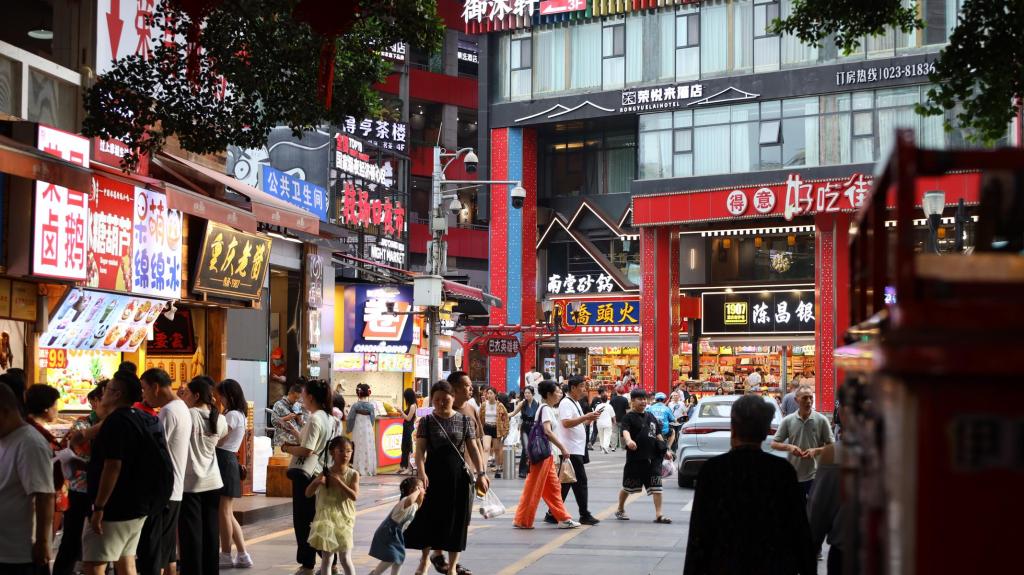
Chongqing strikes me as absurd in many ways, and the impressions hit me so intensely during the first few days that I have a lot to process. I once heard someone say that food is the Chinese religion, and although I have converted to this religion by now, I can’t help but view it critically as well. What I’ve seen and observed in this city strikes me as very consumer-driven and materialistic. Here, it seems that buying and eating can compensate for any problem. Is there an awareness of this? While not only I but also many people around me want to live a simpler, slower, more conscious, and mindful life, here everything seems to strive higher, faster, and further. Progress pushes the crowds through food streets and shopping malls.
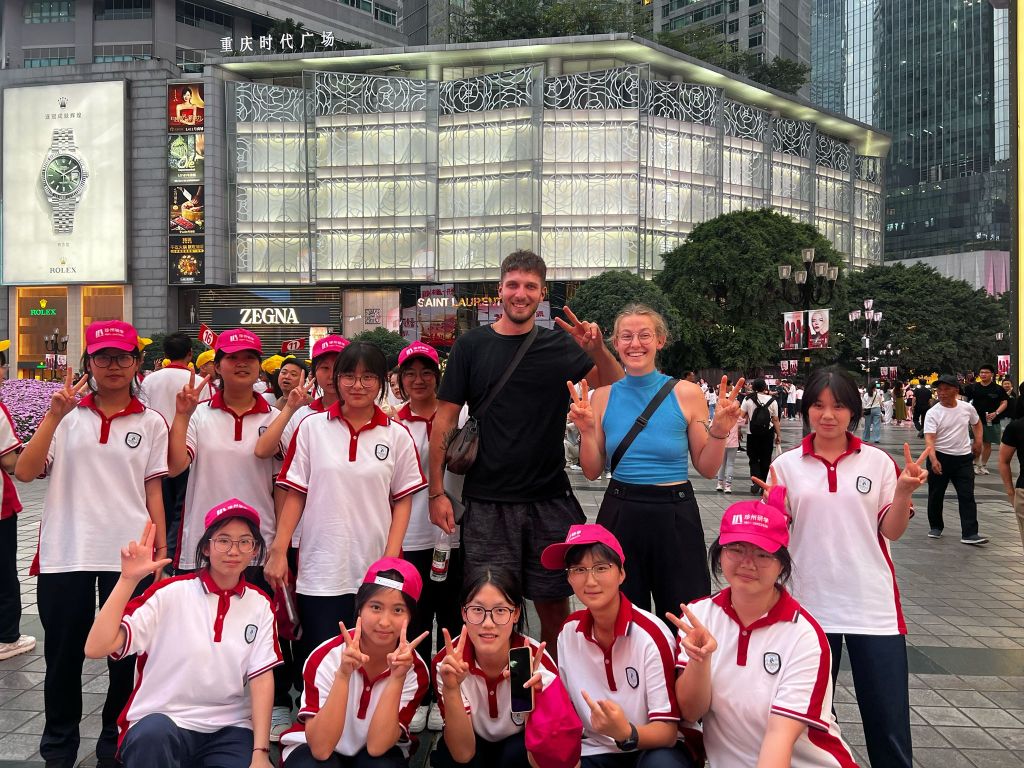
At the same time, I really like Chongqing: all the people, the hustle and bustle, the noise, the food, all these colors and smells. When I’m not out and about, I get really restless at the thought of missing out on this city right at this very moment. Most of the time, I’m greeted by the locals with incredible curiosity and friendliness, even though communication is limited to gestures and body language. Together with Leon, another traveler from Germany whom I met along the way, we’re stopped by a school class. They’re desperate to take pictures with us—group photos, selfies, and even more selfies. If we hadn’t slipped away after a few minutes, we’d probably still be standing there.
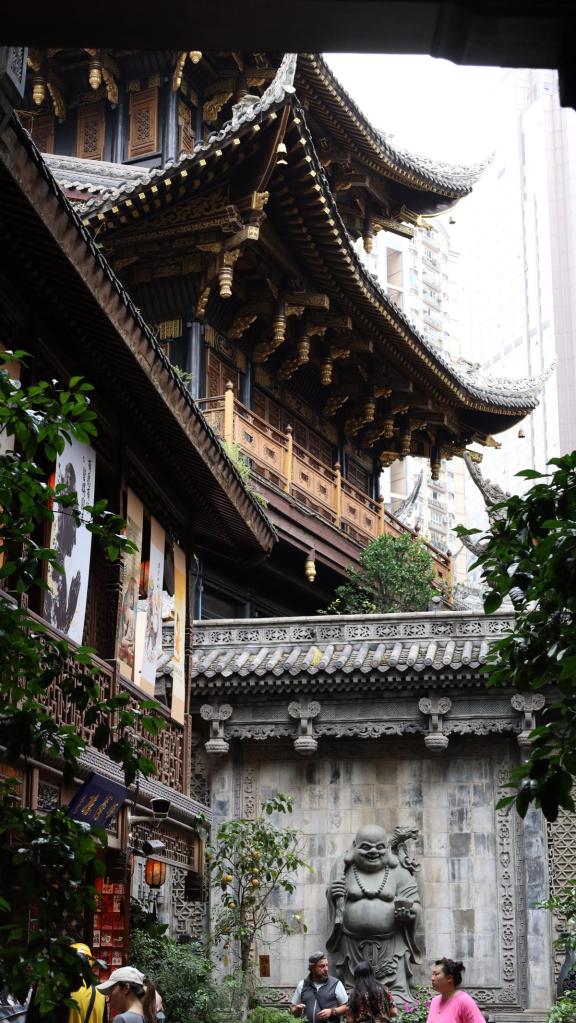
One evening at the hostel, I meet Eva during a card game in the common room. We hit it off right away and will be exploring Chongqing together over the next few days. Aside from eating, we have quite a few things on our agenda, such as the Buddhist Luohan Temple. Right in the middle of the city, nestled between skyscrapers and urban architecture, stands this intricate wooden structure, which is now nearly 1,000 years old. Luohan Temple translates to “Temple of the Arhats,” and in Buddhism, an Arhat is someone who has attained enlightenment. In this temple in Chongqing, there is a room filled with over 500 different Arhat statues. To be honest, I find this room rather unsettling, as many of the figures stare with grim faces and wide eyes, and the cramped, cluttered space makes the atmosphere feel rather oppressive. At the same time, the Luohan Temple is the first Buddhist temple I’ve ever entered, and it marks the beginning of a deep fascination for me.
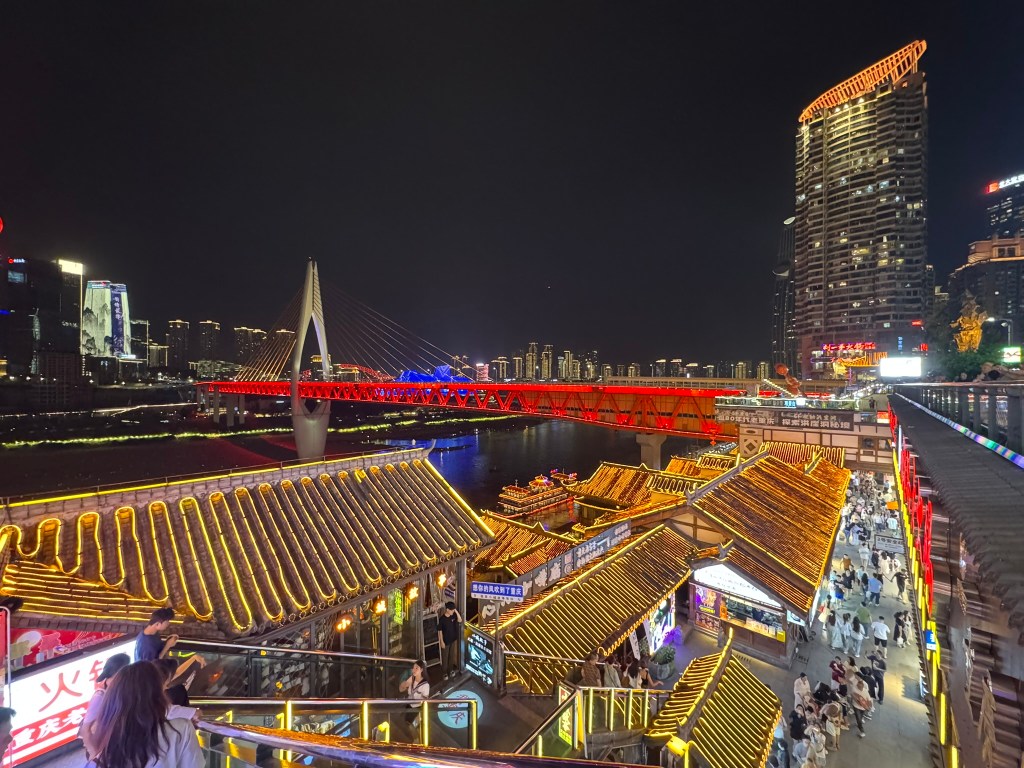
After this long day with relatively little sleep, Eva and I take a short break at the hostel before grabbing another cup of coffee in the common room and doing some research on the club scene. Preparations for our Saturday night are in full swing. It all kicks off at Hongyadong, a massive, eleven-story building complex on the riverbank. Although the building is new, it’s designed in an old Chinese architectural style and, in addition to many shops, naturally houses one thing: food. The entire massive complex is illuminated at night and can be seen from far away by its warm light. In Hongyadong, we meet Tanguy, a traveler from France. He spontaneously joins us.
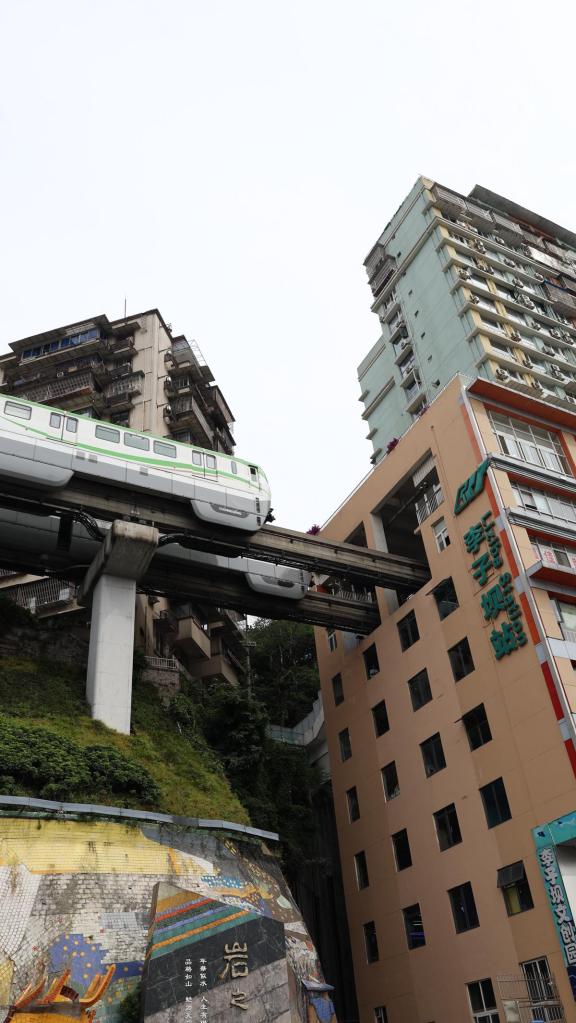
The day after our party is not only another day to explore the city, but also a special day for me. It is May 25, 2025, and thus my second anniversary of traveling. It’s unbelievable where I am now, how much has happened during this time, and how quickly two years can fly by. On this day, I meet up with Eva and Tanguy. Together we hop on the metro and head to Liziba Station, where the next urban wonder—and thus Chongqing’s next unusual sight—awaits us. This very train that we just arrived on actually drives into a building. The metro stop is located inside this building, but not at street level, but between the 6th and 8th floor.
We spend the late afternoon of this day at the Chongqing Art Gallery, where modern art is on display. Afterward, we go out to eat, and I’m especially looking forward to this because we’re visiting the world’s largest hot pot restaurant. With over 5,800 seats, this restaurant was built on terraces along the hillside and features both covered and open-air seating. We find a table in a small pavilion that we have all to ourselves. Partly to celebrate my travel anniversary and partly to celebrate life, we eat until we’re stuffed.
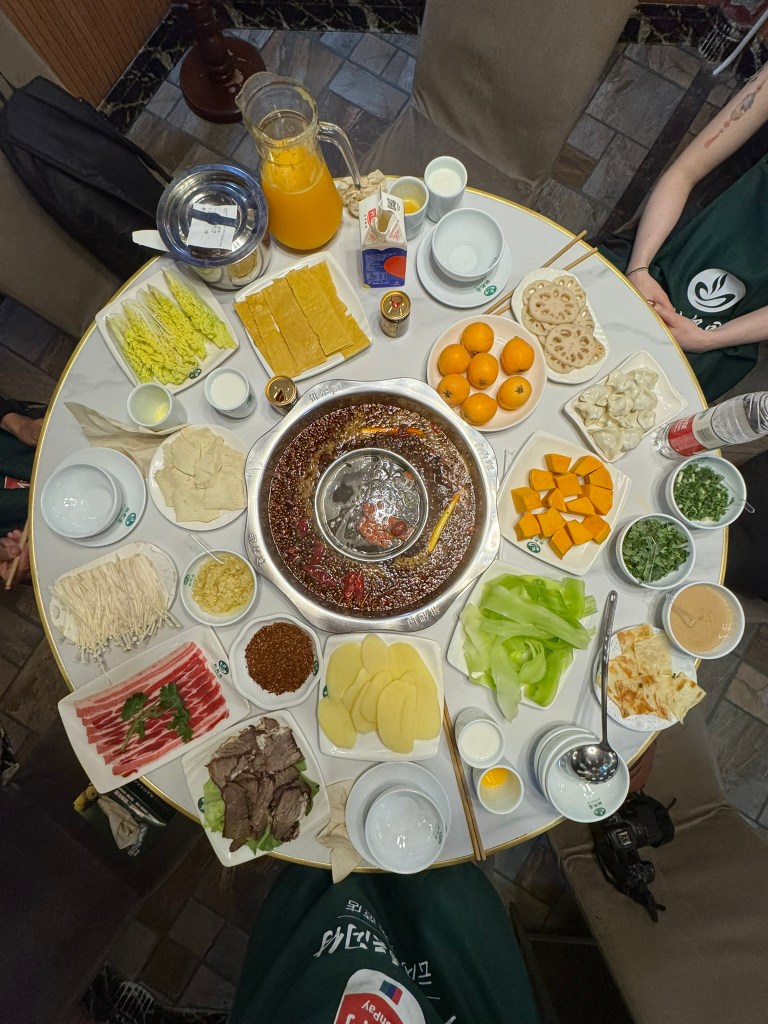
Hot pot is a typical dish in China, especially in the Chongqing region. First, you choose a soup base: vegetable or meat broth, for example, spicy or not so spicy (though the latter should by no means be confused with mild). Then you choose what you want to eat: meat, fish, various vegetables, tofu, or wontons, for example. These are then served in small bowls before being dropped into the hot soup. Once it’s cooked, you fish it out with chopsticks and the meal begins. Hotpot holds a special place in my heart for various reasons. For one thing, it’s simply delicious. For another, it’s the ritual I’ve come to love, since you sit together, share everything, and linger at the table for a long time.
In our case, the large pot of soup is placed in the center of the table, where it simmers away. Chongqing Province borders Sichuan Province, home to the famous Sichuan pepper, whose heat slightly numbs the tongue. In our „not-so-spicy“ soup, plenty of Sichuan peppercorns are floating around. Overall, the evening goes exactly as it should: We order way too much, cry a little from the spiciness, and after a few hours, roll out of the restaurant way too full, with leftovers to go.