
I slowly run my hand over the rock’s surface in front of me while trying to understand its structure. Rocks are something very special to me, especially since I started rock climbing a few years ago. Before I start ascending the wall, I want to know what I will soon be facing at a height of five, ten or fifteen metres: granite or sandstone, warm or cold, dry or damp, all of which will have an important impact on my decisions up there. Which holds to take, for example, or where to put my feet, how long to stay in one place and which places to avoid. If they can be avoided.
Climbing in Kazakhstan
The Kazakh climbing scene is quite active and established, especially in and around Almaty. In addition to bouldering and climbing gyms within the city, the climbing areas outside of town are great too. Many of the routes in Tamgaly-Tas have been bolted in recent years, which is why the bolts and anchor points on the walls are in good condition. Only the crumbly parts on the tuff rock should be treated with caution, which is why helmets are compulsory for belayers, something I learnt from my last accident in Albania.
Apart from that, the number and variety of routes are great, not only for sport climbing but also for trad. One of the most active people within the scene is Kirill Belotserkovskiy. He lives in Almaty, is a mountain guide and climbing instructor. As a part of my internship in Almaty for the Deutsche Allgemeine Zeitung, I was able to interview Kirill in November 2024 and also to film some of his activities:
Note: Video in German language with Russian Subtitles, but interview language is English
High Above River Ili
It’s a glorious autumn day in early October, sunny and warm. In a great mood and in even better company, I look down onto river Ili, which divides this vast landscape. From here, I can see the whirls on the surface of the water, which give me an idea of how strong the current must be in the centre of the river. I can also see our three vans right by the water, our weekend camp.
‘Welcome to paradise!’ is how we were greeted after reaching the site and that’s true. This place truly feels like heaven. After driving along sandy tracks for about half an hour, which connect the main road to this remote place on the river, we set about exploring the area, went for a walk and a swim. After a week and a half of constant traffic jams and crowds in Almaty, the peace and quiet felt twice as good.
Yet, there were people around us pretty frequently this weekend: families and curious children as well as other climbers. Tamgaly-Tas is not only known as the largest sport climbing area in Kazakhstan, but also for its ancient petroglyphs. These date back several centuries and show images and symbols from Buddhism.
The word petroglyph comes from Greek language and consists of the words for stone and engraving. People’s fascination with rocks and with immortalising themselves in stone seems to go way back in time. It is probably the same with climbing: discovering, exploring new possibilities and finding new paths in the vertical.
Dependence and Fear
Like other outdoor sports, climbing is a very grounding experience for me. In the tranquillity of nature, I always find my way back to myself and realise how small I actually am, right next to this huge wall. With every move and every metre of altitude I disappear more and more for the world below, immersing into my dependence on the rock, the plants and animals around me, the weather and, last but not least, the person belaying me on the other end of the rope.
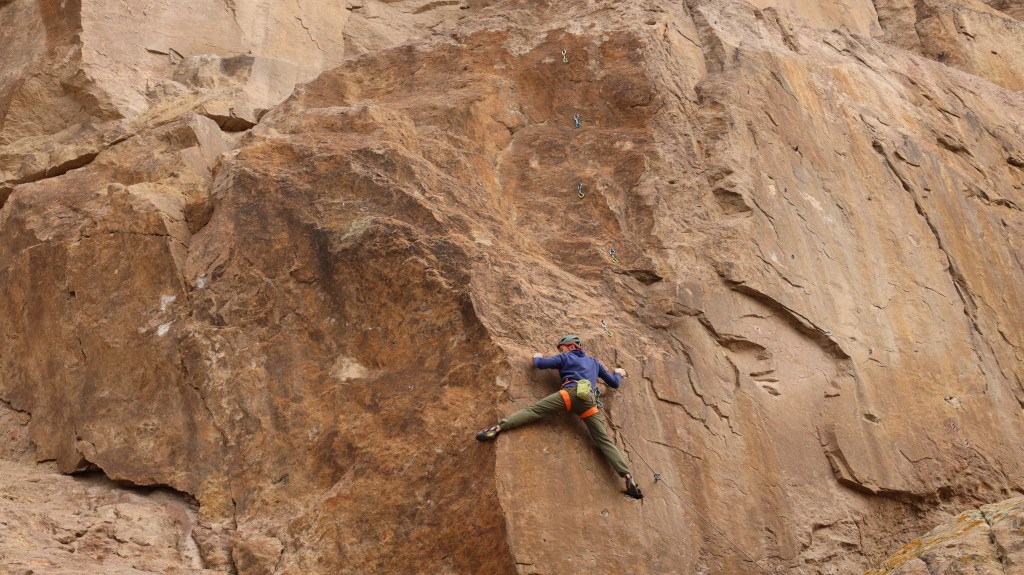
I deep dive into a pure state of focus and I become almost meditatively aware of my own breath and thoughts. The pivot point of climbing lies in dealing with fear and one of the most famous German climbers, Alexander Huber, has dedicated an entire book to it.
Of course, the feeling of climbing up a straight wall at a height of a few metres while only being attached to a rope is anything but comfortable at first. So fear is simply a natural and healthy survival mechanism of the body to communicate and say: Hey, are you sure about that? Not wanting to be afraid is therefore perhaps not so desirable after all, as it also makes you alert and focussed in the short term. However, being able to deal with fear and to not let it take over, to find a constructive approach to it and perhaps even to use it to your own advantage seems to make sense.
While my body ascents, my head dives. I breathe deeply, become aware of my thoughts and put them aside for a while. Simply don’t think too much now, I think. Don’t wait too long, otherwise your head might go nuts. To lose or not to lose control, that is the question. Something that probably comes with time.
Eventually, one gets smaller and smaller for the world below on the way up. Until the belayer tightens the rope and that’s it. It’s time to enjoy the view at the top, proudly looking back down to see what one can do.
This text is part of an article that was published in German language November in the Deutsche Allgemeine Zeitung.
 das leben geht vor